
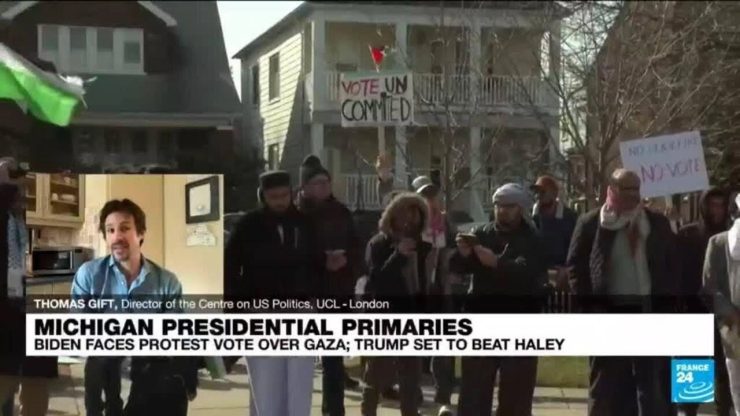
While Joe Biden and Donald Trump are marching toward their respective presidential nominations, Michigan’s primary on Tuesday could reveal significant political perils for both of them. Trump, despite his undoubted dominance of the Republican contests this year, is facing a bloc of stubbornly persistent GOP voters who favor his lone remaining rival, former U.N. Ambassador Nikki Haley, and who are skeptical at best about the former president’s prospects in a rematch against Biden. As for the incumbent president, Biden is confronting perhaps his most potent electoral obstacle yet: an energized movement of disillusioned voters upset with his handling of the war in Gaza and a relationship with Israeli Prime Minister Benjamin Netanyahu that critics say has been too supportive. Those dynamics will be put to the test in Michigan, the last major primary state before Super Tuesday and a critical swing state in November’s general election. Even if they post dominant victories as expected on Tuesday, both campaigns will be looking at the margins for signs of weakness in a state that went for Biden by just 3 percentage points last time.vBiden said in a local Michigan radio interview Monday that it would be “one of the five states” that would determine the winner in November.vMichigan has the largest concentration of Arab Americans in the nation. More than 310,000 residents are of Middle Eastern or North African ancestry. Nearly half of Dearborn’s roughly 110,000 residents claim Arab ancestry. It has become the epicenter of Democratic discontent with the White House’s actions in the Israel-Hamas war, now nearly five months old, following Hamas’ deadly Oct. 7 attack and kidnapping of more than 200 hostages. Israel has bombarded much of Gaza in response, killing nearly 30,000 people, two-thirds of them women and children, according to Palestinian figures. Democrats angry that Biden has supported Israel’s offensive and resisted calls for a cease-fire are rallying voters on Tuesday to instead select “uncommitted.” The “uncommitted” effort, which began in earnest just a few weeks ago, has been backed by officials such as Democratic Rep. Rashida Tlaib, the first Palestinian-American woman in Congress, and former Rep. Andy Levin, who lost a Democratic primary two years ago after pro-Israel groups spent more than $4 million to defeat him. Abbas Alawieh, spokesperson for the Listen to Michigan campaign that has been rallying for the “uncommitted” campaign, said the effort is a “way for us to vote for a ceasefire, a way for us to vote for peace and a way for us to vote against war.” Trump won the state by just 11,000 votes in 2016 over Democratic candidate Hillary Clinton, and then lost the state four years later by nearly 154,000 votes to Biden. Alawieh said the “uncommitted” effort wants to show that they have at least the number of votes that were Trump’s margin of victory in 2016, to demonstrate how influential that bloc can be. As Biden and Trump face their own party tests in Michigan’s primaries, foreshadowing of a highly-likely November rematch, FRANCE 24’s Nadia Massih is joined by Thomas Gift, Director of the University College of London’s (UCL) Centre on US Politics (CUSP).
‘Post-persuasion politics’: US presidential election in November set to be ‘battle of personalities’






Add comment