Cambodia has called for an “immediate” ceasefire with Thailand, as the two countries have seen more than 30 people killed, including civilians, in the ongoing border clashes. Cambodia’s ambassador to the UN, Chhea Keo, said his country asked for a truce “unconditionally”, adding that Phnom Penh also wanted a “peaceful solution of the dispute”. Thailand has not publicly commented on the proposal, while rejecting third-party mediation. It earlier declared martial law in eight districts bordering Cambodia. At least 32 people – soldiers and civilians – have been killed and nearly 200,000 displaced in the two Southeast Asian countries, who accuse each other of firing the first shots on Thursday. Continued below this next explainer clip
This 60 second video will let you know exactly what’s going on between Cambodia and Thailand and why they are at War Must watch
This 60 second video will let you know exactly what’s going on between Cambodia and Thailand and why they are at War
Must watch pic.twitter.com/cPnew4yd0h
— Culture War Report (@CultureWar2020) July 24, 2025
Escalating Tensions: The 2025 Cambodia-Thailand Border Conflict
The border between Cambodia and Thailand, long a flashpoint of historical grievances, has erupted into deadly clashes in July 2025, marking the most severe confrontation between the two Southeast Asian neighbors in over a decade. Cambodia’s call for an immediate ceasefire, as highlighted in a BBC News report aggregated by Whatfinger News (Vid above), underscores the urgency of the situation as the death toll climbs and thousands flee their homes.
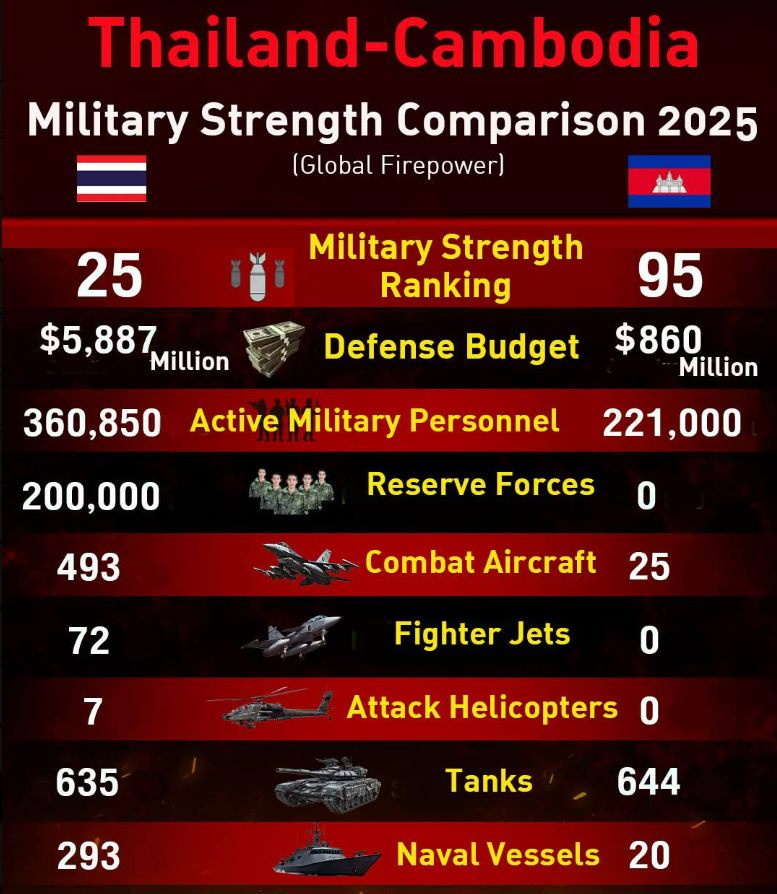
What began as accusations over landmines and territorial incursions has escalated into heavy artillery exchanges, displacing nearly 200,000 people and claiming at least 32 lives. This conflict revives deep-seated disputes rooted in colonial-era maps and national pride, threatening regional stability and drawing international pleas for de-escalation. The roots of the Cambodia-Thailand border conflict trace back more than a century to the French colonial period in Indochina. During the early 20th century, France, as Cambodia’s colonial ruler, drew borders that Thailand (then Siam) contested, particularly around ancient Khmer temples like Preah Vihear. In 1962, the International Court of Justice (ICJ) awarded Preah Vihear Temple to Cambodia, a ruling Thailand reluctantly accepted but never fully reconciled with, especially regarding surrounding lands. Continued below Trump’s post at Truth Social
🔺🇰🇭❌🇹🇭:
Cambodia shot down a Thailand’s F-16 using its Chinese-made KS-1C Air Defence System. pic.twitter.com/fnybCO3Pm1— Tactical Tribune (@TacticalTribun) July 26, 2025
Despite joint border commissions and bilateral talks, underlying issues—such as differing interpretations of colonial treaties and mutual distrust—remained unresolved, setting the stage for the current crisis. The 2025 escalation began in mid-July with incidents that both sides blame on the other. Thailand accused Cambodian forces of planting fresh landmines in disputed areas, wounding several Thai soldiers, including one who lost a limb.
In response, Bangkok recalled its ambassador from Phnom Penh and expelled Cambodia’s envoy, plunging diplomatic relations to their lowest point in years. Cambodia denied the allegations, countering that Thai troops violated prior agreements by advancing toward Khmer-Hindu temples near the border. Tensions boiled over on July 24, when heavy fighting broke out along multiple points in provinces like Surin and Oddar Meanchey. Both nations traded accusations of firing first: Thailand claimed Cambodian drones conducted provocative surveillance, while Cambodia alleged Thai aggression initiated the clashes.
As the conflict entered its third day on July 26, the violence intensified, spreading to new fronts including coastal areas in Thailand’s Trat province and Cambodia’s Pursat. Reports detail exchanges of heavy artillery, rocket launchers, and even airstrikes, with Thailand deploying F-16 jets for bombing runs. Cambodia accused Thailand of using cluster munitions—banned under international law for their indiscriminate impact—causing civilian casualties and damaging sites like schools and pagodas. Thailand denied targeting civilians, instead alleging Cambodia used human shields by positioning weapons near residential areas.
Thailand–Cambodia Conflict Update 🇹🇭⚔️🇰🇭
Border tensions escalate with ongoing clashes and rising casualties. What’s next? pic.twitter.com/kUG0Ccf3hm
— World War 3 (@Worldwar_3_) July 26, 2025
The death toll has risen rapidly: Thai sources report 19 fatalities (13 civilians, 6 soldiers), while Cambodia confirms 13 deaths (8 civilians, 5 soldiers), with dozens more wounded. Evacuations have been massive, with over 131,000 displaced in Thailand and thousands in Cambodia seeking shelter in schools and sports complexes. Martial law was declared in eight Thai border districts, heightening fears of further escalation.
Amid the chaos, Cambodia appealed to the United Nations on July 25, with Ambassador Chhea Keo calling for an “immediate, unconditional” ceasefire after a closed-door Security Council meeting. Keo emphasized Cambodia’s desire for a peaceful resolution, questioning how a smaller nation without an air force could aggress against Thailand’s superior military. Thailand’s response has been cautious; Foreign Minister Maris Sangiampongsa demanded “genuine sincerity” from Phnom Penh before talks, rejecting third-party mediation and insisting on bilateral solutions.
Cambodian Prime Minister Hun Manet accused Thailand of initially agreeing to a Malaysian-brokered ceasefire before backtracking, calling it “regrettable.” International reactions have been swift and unified in urging restraint. The UN Security Council expressed grave concern, calling for de-escalation and civilian protection. ASEAN Chair Malaysia, under Prime Minister Anwar Ibrahim, offered to facilitate talks, a proposal Cambodia supports but Thailand views skeptically.
The United States, China, the European Union, Australia, and France have all appealed for an immediate halt to hostilities, with U.S. officials expressing sadness over civilian harm. China, with ties to both nations, advocated dialogue, while the ICJ’s past role looms as a potential avenue for resolution—Cambodia recently sought court intervention in June 2025. The causes of this conflict are multifaceted, blending historical territorial claims with modern geopolitical dynamics. Nationalism plays a key role; in Thailand, under an acting government, border issues rally domestic support amid political instability. Cambodia, led by Hun Manet’s administration, views encroachments as threats to sovereignty, especially around culturally significant sites.
Resource competition—potential oil, gas, and timber in disputed areas—adds economic stakes, though rarely acknowledged publicly. Climate change and migration pressures along the border may also exacerbate frictions, as communities compete for scarce resources. The human cost is stark: Evacuees describe terror from rocket attacks, reminiscent of past wars, with children and elderly bearing the brunt. If unchecked, Thai warnings of “moving toward war” could materialize, destabilizing ASEAN and drawing in external powers. Yet, history shows diplomacy can prevail— the 2011 ceasefire offers a blueprint. As fighting persists despite calls for peace, the world watches, hoping cooler heads will prevent a full-scale catastrophe.
Links
- Cambodia calls for ‘immediate ceasefire’ with Thailand as deadly clashes enter a third day
- Cambodia calls for ‘immediate ceasefire’ with Thailand as deaths rise
- Thailand-Cambodia Border Clash: At least 33 Killed in Border Standoff
- Thailand Warns of War With Cambodia as Deadly Clashes Enter Third Day
- Tens of thousands flee Thailand-Cambodia fighting
- 2025 Cambodia–Thailand border conflict
- Thailand and Cambodia exchange heavy artillery fire as border battle expands
- At least 33 People Killed in Thailand & Cambodia Amid Clashes
- Thailand warns clashes with Cambodia could ‘move towards war’
- Cambodia confirms first deaths in cross-border conflict with Thailand
- Tens of thousands flee their homes as Thailand and Cambodia clash
- UN urges restraint as Thailand-Cambodia clashes displace thousands
- Cambodia calls for ceasefire with Thailand as death toll rises
- Cambodia calls for ‘immediate ceasefire’ with Thailand as deadly clashes enter a third day
- Cambodia calls for ‘immediate ceasefire’ with Thailand as deaths rise
- Cambodia calls for ceasefire with Thailand, AFP reports
- Thailand and Cambodia exchange heavy artillery fire as border battle expands
- Thai-Cambodian fighting extends into third day despite ceasefire calls
- Cambodia calls for ceasefire with Thailand as death toll rises – BBC News
- Thai leader warns clashes with Cambodia could ‘move toward war’
- Thai-Cambodian fighting extends into third day, Malaysia urges ceasefire
- Cambodia calls for immediate ceasefire with Thailand as death toll rises | BBC News – World News
Sgt K with Luke at Whatfinger News. X Posts and Grok as well as quotes from links above
More on the Thai-Cambodian War.
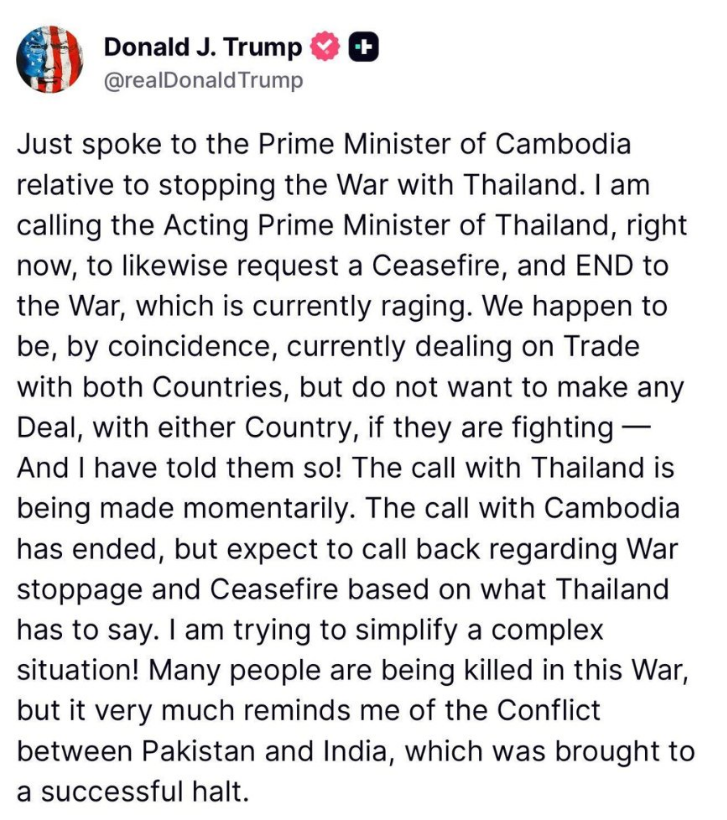
- BREAKING: President Trump just said he is CURRENTLY working to stop the war between Cambodia and Thailand. This comes as he was seen on the golf course in Scotland. THIS GUY NEVER STOPS. Trump says he is using the USA’s trade leverage to call a ceasefire. Masterclass. “Just spoke to the Prime Minister of Cambodia relative to stopping the War with Thailand. I am calling the Acting Prime Minister of Thailand, right now, to likewise request a Ceasefire, and END to the War, which is currently raging. We happen to be, by coincidence, currently dealing on Trade with both Countries, but do not want to make any Deal, with either Country, if they are fighting — And I have told them so! The call with Thailand is being made momentarily. The call with Cambodia has ended, but expect to call back regarding War stoppage and Ceasefire based on what Thailand has to say. I am trying to simplify a complex situation! Many people are being killed in this War, but it very much reminds me of the Conflict between Pakistan and India, which was brought to a successful halt.”
After 2 years of reporting fake news against Israel in Gaza, the BBC is now doing the same against Thailand
They used this picture of a Cambodian artillery strike on a Thai 7-eleven & gas station (where 8 civilians were killed) to falsely frame it as Thai airstrikes on Cambodia pic.twitter.com/fOF81U38Yx
— Visegrád 24 (@visegrad24) July 26, 2025
FAKE NEWS Washington Post lies as usual. Check this out – – –
Thailand launched airstrikes on Cambodia on Thursday following a new border clash.
Fighting between the two countries has occurred intermittently for decades, but tensions began to climb last month after a Cambodian soldier was killed in a skirmish. https://t.co/O14SfG2ckk pic.twitter.com/8dKghOuTW3
— The Washington Post (@washingtonpost) July 24, 2025
- Fakebook doesn’t want you reading most sites we link to or any vids we post. Their algorithm hides our pages and humor too as best it can. The way to stick it to Zuckerberg? Sign up for our once-a-day newsletter. Takes 6 seconds. We send out the best – most popular links daily, no spam, plus a splash of honesty even beyond Whatfinger’s homepage…. – CLICK HERE